Design & Architecture Journal
Bathroom Insights & Trends
How to Choose Wall Mounted Urinals in 2026?
Table of Contents
- Define Your Space, Users, and Installation Requirements
- Compare Urinal Types, Materials, and Flushing Systems
- Evaluate Water Efficiency, Hygiene, and Accessibility Features
- Check Plumbing Compatibility, Dimensions, and Mounting Methods
- Select Reliable Products and Plan Installation and Maintenance
- FAQS
- Conclusion
- Related Posts
Choosing Wall Mounted Urinals in 2026 requires more than comparing prices, bowl shapes, and flush buttons. Facility managers must examine water use, wall structure, hygiene, accessibility, maintenance, and user comfort together. The U.S. Environmental Protection Agency’s WaterSense specification identifies efficient urinals using no more than 0.5 gallons per flush, while older commercial models may use 1.0 gallon or more. That difference becomes substantial in airports, schools, stadiums, and busy workplaces.
Market research also shows growing demand for water-efficient bathroom fixtures. Grand View Research reports that sustainability and smart-building upgrades are influencing the global bathroom products market. However, market growth does not guarantee a suitable product. A compact urinal may save wall space but create splash concerns. A sensor model may reduce touchpoints but require dependable batteries and cleaning around the detection window. Small details matter.
“ The cheapest water is the water we don’t use,” says Mary Ann Dickinson, founder of the Alliance for Water Efficiency. Her statement offers a useful starting point, but water savings alone should not decide the purchase. Drain capacity, flush performance, replacement parts, and installation access deserve equal attention. The EPA’s WaterSense criteria are helpful, yet they cannot predict every real-world maintenance problem. A careful buyer should test samples, review technical data, and speak with installers before committing. The perfect model may not exist. The practical choice is the one that performs consistently, fits the building, and remains serviceable after years of daily use.
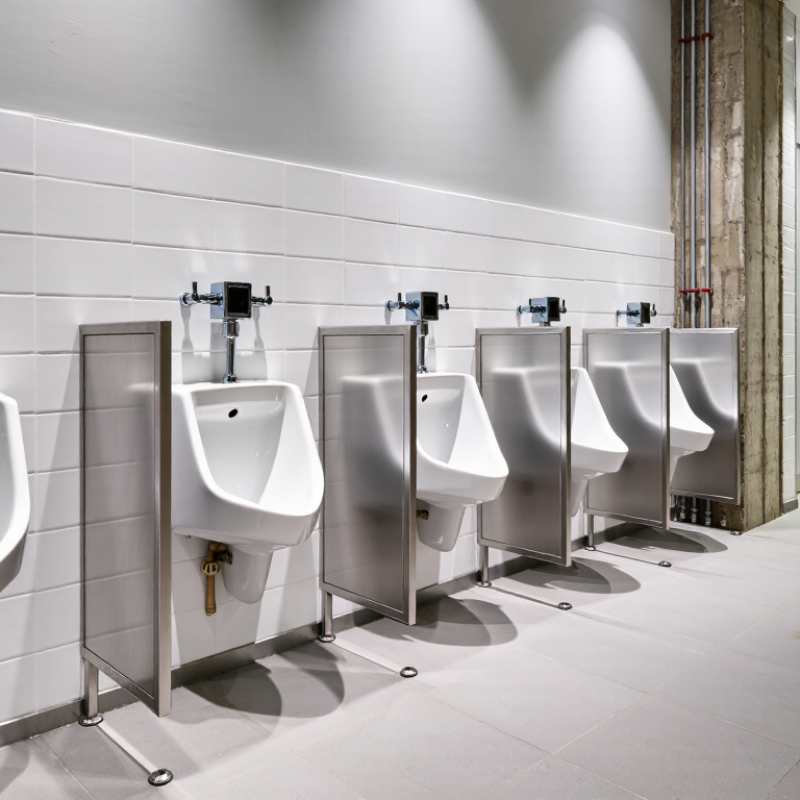
Define Your Space, Users, and Installation Requirements
Before choosing a wall-mounted urinal, measure the room as users experience it. Record wall width, ceiling height, door swing, partitions, and drain locations. A drawing can hide awkward details. A tape measure will not.
The U.S. EPA WaterSense Urinal Specification limits qualifying models to 0.5 gallons per flush or less. That figure helps compare water demand, but flush performance still depends on supply pressure and drainage design. Confirm the available pipe size and rough-in height with a qualified plumber. For accessibility planning, the 2010 ADA Standards specify at least one urinal with a rim no higher than 17 inches above the finished floor. They also require clear floor space. Local rules may differ.
Define the users before selecting the bowl. Busy offices need durable surfaces, quick cleaning, and reliable flushing. Schools may need stronger privacy screens and lower mounting options. Healthcare spaces require careful hygiene planning and easy access for maintenance. Allow enough shoulder room between fixtures. Crowding creates splashing, queues, and poor cleaning access. According to the EPA WaterSense specification, lower-flow fixtures can reduce water use, yet improper installation may waste more through leaks and repeated flushing. I would recheck the drainage slope, wall reinforcement, and service access before ordering. Looks matter, but access matters longer.
Compare Urinal Types, Materials, and Flushing Systems
How to Choose Wall Mounted Urinals in 2026?
Wall-mounted urinals usually fall into washout, siphon-jet, and blowout designs. Washout models suit quieter, moderate-use restrooms. Siphon-jet bowls handle heavier traffic but need careful drainage design. Blowout types clear waste forcefully, although they can be louder. Check the carrier, rough-in depth, and trap alignment before choosing the bowl. A beautiful fixture cannot correct poor wall reinforcement.
Material changes maintenance. Vitreous china offers a smooth, stain-resistant surface and remains the practical standard. Stainless steel resists impact in schools, transport facilities, and busy public toilets. Solid-surface materials can look refined, but scratches may become visible under harsh cleaning. I once overvalued appearance. Cleaning access mattered more.
Flushing systems need closer comparison. The U.S. EPA WaterSense Commercial Urinals Specification limits labeled models to 0.5 gallons per flush, compared with older 1.0-gallon fixtures. EPA’s WaterSense at Work guidance also stresses leak control and correct valve adjustment in commercial facilities. Manual diaphragm valves are simple and dependable. Sensor valves reduce touchpoints, but false activations can waste water. Battery replacement is another small failure point. Select a 0.125, 0.25, or 0.5-gallon setting only after checking drain performance and local plumbing requirements. Lower flow is not automatically better. EPA WaterSense, Commercial Urinals Specification, Version 1.0; WaterSense at Work, U.S. Environmental Protection Agency.
How to Choose Wall Mounted Urinals in 2026? - Compare Urinal Types, Materials, and Flushing Systems
| Comparison Factor | Standard Wall-Mounted Urinal | Waterless Urinal | Low-Consumption Flush Urinal | Washout Urinal | Stall-Type or Trough Urinal |
|---|---|---|---|---|---|
| Typical Design | Individual bowl fixed to a wall carrier or support frame. | Individual bowl designed to operate without a conventional water flush. | Individual bowl using a reduced-volume flush valve or cistern. | Water enters near the upper rim and washes the bowl surface toward the outlet. | Long shared fixture intended for several users at the same time. |
| Best-Suited Locations | Offices, schools, restaurants, hotels, and general commercial washrooms. | Buildings where water conservation is a priority and maintenance procedures are well controlled. | High-use public and commercial washrooms seeking lower water consumption. | Facilities requiring strong bowl rinsing and straightforward internal geometry. | Sports venues, factories, transportation facilities, and high-traffic public washrooms. |
| Water Consumption | Commonly 1.9–3.8 L per flush Actual consumption depends on the flush valve, supply pressure, and local plumbing requirements. |
0 L per flush Uses a liquid seal, cartridge, or membrane system instead of a routine water flush. |
Approximately 0.5–1.9 L per flush Low-flow models must be compatible with the drainage system and applicable plumbing codes. |
Commonly 3.8–7.6 L per flush Higher flow can provide effective rinsing but increases water use. |
Varies by length and valve setting Shared fixtures may require timed or sensor-controlled flushing to manage consumption. |
| Common Bowl Materials | Vitreous china, stainless steel, or sanitary ceramic. | Vitreous china, ceramic, stainless steel, or specially coated composite materials. | Vitreous china and sanitary ceramic are most common; stainless steel is used in vandal-resistant installations. | Vitreous china and ceramic are common because they provide a smooth, cleanable surface. | Stainless steel, vitreous china, ceramic, or solid-surface composite, depending on the installation environment. |
| Vitreous China | Glossy, nonporous, corrosion-resistant, and relatively easy to clean. | Suitable when the bowl is paired with a compatible waterless waste outlet. | Provides a smooth surface that supports hygiene and efficient rinsing at low flush volumes. | Works well with washout flushing because the glazed surface resists staining. | Durable and hygienic, although long trough sections can be heavy and require strong wall support. |
| Stainless Steel | Strong, impact-resistant, and suitable for demanding commercial environments. | Can be used where impact resistance is important, but the waste-seal system still requires regular service. | Resistant to impact and vandalism; surface finish affects visibility of water spots and scratches. | Provides good durability in high-traffic installations when correctly fabricated and supported. | Often preferred for heavy-duty, high-use, or correctional applications. |
| Flush System Options | Manual handle, exposed flush valve, concealed flush valve, or infrared sensor. | No routine flush; uses a cartridge, membrane, liquid seal, or mechanical trap system. | Water-saving flush valve, pressure-assisted valve, or sensor-operated valve. | Flush ring or spreader inlet that distributes water across the upper bowl area. | Timed flush, manual flush, sensor flush, or central flush control for multiple users. |
| Hygiene Performance | Good when the bowl is cleaned regularly and the flush provides adequate coverage. | Good when the seal is maintained correctly; neglected cartridges can produce odors or drainage problems. | Good if the reduced flow is sufficient for the bowl shape, drain design, and usage level. | Generally good bowl coverage, although splash control and outlet design should be checked. | Depends strongly on the flushing pattern, user density, drainage slope, and cleaning frequency. |
| Installation Requirements | Wall carrier or reinforced wall, water supply, waste connection, and access for valve servicing. | Wall support and waste connection; water supply may not be required for the fixture itself. | Reinforced wall, compatible low-flow valve, adequate water pressure, and correctly sized drainage. | Wall carrier, water supply capable of providing the specified flush volume, and suitable waste connection. | Continuous structural support, accurately positioned waste outlets, and coordinated flush and drainage layout. |
| Typical Projection from Wall | Approximately 300–400 mm Compact models may project less; accessible models can require additional clearance. |
Approximately 300–400 mm Projection varies according to the bowl and cartridge design. |
Approximately 300–400 mm Choose a compact bowl where circulation space is limited. |
Approximately 300–400 mm Confirm the projection with the carrier and flush inlet dimensions. |
Approximately 300–500 mm Long troughs may need additional clearance for cleaning and user movement. |
| Maintenance Needs | Clean bowl and flush outlet; inspect seals, valve operation, and wall connections. | Scheduled cartridge or seal replacement, odor control, outlet cleaning, and staff training. | Clean sensor or handle, inspect valve filters, and verify that the low-flow setting remains effective. | Remove scale from spreaders and flush passages; check for uneven water distribution. | Clean the full length of the fixture, inspect multiple outlets, and keep shared drainage clear. |
| Main Advantages | Versatile, widely available, familiar to installers, and suitable for many building types. | Can eliminate routine flush-water use and reduce demand on water and drainage infrastructure. | Balances water saving with a conventional flushing experience. | Strong rinsing action and relatively simple bowl geometry. | High user capacity, efficient use of wall space, and fewer individual bowls to install. |
| Main Limitations | Uses potable water and may require more frequent cleaning in high-use areas. | Requires disciplined maintenance; unsuitable servicing can lead to odor, blockage, or seal failure. | Very low flow may not be appropriate for every drainage layout or heavily used facility. | Usually consumes more water than low-flow or waterless alternatives. | Offers less privacy and may require careful control of splash, odor, drainage, and cleaning access. |
| Recommended Selection Priority | Choose when you need a dependable general-purpose fixture with conventional servicing. | Choose when water conservation is critical and a reliable maintenance program is available. | Choose when reducing water use is important but a standard flush experience is preferred. | Choose when bowl rinsing and simple, visible flushing performance are more important than minimum water use. | Choose when capacity and durability are more important than privacy or individual-user separation. |
Evaluate Water Efficiency, Hygiene, and Accessibility Features
How to Choose Wall Mounted Urinals in 2026?
Water efficiency should start with the flush volume, not the showroom appearance. The U.S. EPA WaterSense Specification for Flush Valve Water Closets and Urinals allows qualifying urinals to use no more than 0.5 gallons per flush. That is 50% below the older 1.0-gallon federal benchmark. Confirm the actual flush setting, because poor calibration can waste water and cause odor problems. Drainage matters too. A very low flush may fail when pipe slopes, usage patterns, or maintenance are overlooked.
Hygiene depends on more than touchless activation. Infrared sensors can reduce hand contact, while smooth vitreous surfaces simplify daily cleaning. Look for protected sensor lenses and accessible service panels. In busy washrooms, splash control is practical. It keeps nearby floors drier. However, sensor systems are not automatically hygienic. Incorrect detection ranges can trigger repeated flushes. The EPA’s WaterSense program stresses performance testing, but real buildings still need inspection records and cleaning routines.
Accessibility deserves a physical check before purchase. The 2010 ADA Standards specify a wall-hung urinal rim no higher than 17 inches above the finished floor. They also require clear floor space and reachable flush controls. Local rules may differ. Measure with the finished wall and floor installed. A 2023 WHO and UNICEF JMP report noted that billions still lack safely managed sanitation, reminding designers that reliable operation matters. I would not choose the lowest-flow model blindly. Water savings are valuable, but failed flushing, blocked drains, and difficult maintenance can erase them quickly.
Check Plumbing Compatibility, Dimensions, and Mounting Methods
How to Choose Wall Mounted Urinals in 2026?
Start with the plumbing, not the appearance. Measure the waste outlet, water-supply position, rough-in depth, and wall cavity. A wall-mounted urinal may require a concealed carrier, reinforced studs, or a suitable masonry fixing point. Flush valve pressure also matters. Low pressure can cause weak flushing and repeated cleaning problems. The EPA WaterSense Specification for Urinals limits labeled models to 0.5 gallons per flush, supporting lower water use without ignoring drainage performance.
Dimensions need a physical check. Record the bowl width, projection from the wall, rim height, and service access. The 2010 ADA Standards specify a wall-hung urinal rim no higher than 17 inches above the finished floor. They also require clear floor space around accessible fixtures. Local codes may be stricter. A neat drawing can still mislead when tile thickness changes the final projection.
Tips: Photograph existing connections before ordering. Confirm the carrier’s load rating and fixing surface. Leave access for the flush valve. Two people should test the mounting height. I once treated a rough-in measurement as exact; it was not. Recheck it. EPA WaterSense’s 2023 annual report says labeled products have helped save trillions of gallons nationally, but installation quality still determines real-world results. Consider water pressure, user height, cleaning routines, and future repairs before selecting the mounting method.
How to Choose Wall-Mounted Urinals in 2026?
Check plumbing compatibility, dimensions, and mounting methods before installation.
Planning reference: For accessible installations, the urinal rim should be no higher than 17 inches above the finished floor. The required clear floor space is at least 30 inches wide by 48 inches deep, and operable flush controls should generally be no higher than 48 inches.
Before selecting a wall-mounted model, confirm the waste outlet size and position, water-supply connection, carrier or wall-support capacity, finished wall thickness, and the required mounting height. A 2-inch waste connection and 1/2-inch water supply are common planning references, but local plumbing codes and the fixture installation instructions take priority.
Select Reliable Products and Plan Installation and Maintenance
Choosing a wall-mounted urinal in 2026 requires more than comparing prices. Select a vitreous surface that resists staining and cleans easily. Check the bowl depth, rim shape, and waste outlet position before ordering. A strong fixing system must support the fixture without stressing the wall. Solid masonry usually needs different anchors from a framed partition. Confirm the load requirements with a qualified installer.
Plan the installation around real daily use. Leave enough shoulder and knee space, especially in busy commercial washrooms. Confirm the water pressure, flush volume, pipe route, and drainage slope. Local plumbing and accessibility rules may affect the height and clearances. Sensor flushing can reduce touch points, but it still needs reliable power or battery access. Manual valves are simpler, yet users may leave them running. Neither option is perfect. I would rather choose a serviceable system than a clever one that is difficult to repair.
Tips: Keep shut-off valves reachable. Add a removable access panel where possible. Use corrosion-resistant screws and sealed joints. Inspect flushing, leaks, odors, and wall movement during routine maintenance. Clean the trap and outlet according to the installer’s instructions. Do not use harsh chemicals without checking surface compatibility. Even experienced teams can overlook splash patterns, so test the fixture after installation and adjust nearby partitions if necessary.
FAQS
Measure wall width, ceiling height, door swing, partitions, drain locations, and rough-in height. A tape measure reveals awkward details. A drawing may hide them.
A qualifying efficient model uses no more than 0.5 gallons per flush. That is half the older 1.0-gallon benchmark. Confirm the actual setting.
Yes. Weak drainage, poor pipe slopes, or incorrect calibration can cause odors and repeated flushing. Water savings can disappear quickly. Check the full drainage system.
Busy offices need durable surfaces and quick cleaning. Schools may need stronger privacy screens and lower mounting options. Healthcare areas need careful hygiene and service access.
Accessibility standards commonly require at least one urinal rim no higher than 17 inches above the finished floor. Provide clear floor space and reachable controls. Measure after the finished floor is installed.
No. Sensors reduce hand contact, but incorrect detection ranges may trigger repeated flushes. Choose protected sensor lenses. Keep service panels accessible.
Smooth vitreous surfaces simplify daily cleaning. Splash control helps keep nearby floors drier. Leave enough shoulder room between fixtures.
Recheck wall reinforcement, drainage slope, supply pressure, pipe size, rough-in height, and maintenance access. Looks can mislead. I might prioritize appearance too quickly.
Conclusion
Choosing Wall Mounted Urinals in 2026 begins with understanding your space, expected users, and installation conditions. Consider the available wall area, user capacity, privacy needs, and whether the existing plumbing can support the selected layout. Compare different urinal types, materials, and flushing systems based on durability, cleaning requirements, water consumption, and long-term operating costs. Ceramic, stainless steel, and other suitable materials may offer different benefits for commercial, public, or residential environments.
Water efficiency, hygiene, and accessibility should also guide your decision. Look for reliable flushing performance, touchless or easy-to-operate controls, smooth surfaces, and features that support users with different mobility needs. Before purchasing, verify dimensions, inlet and outlet positions, mounting structure, and maintenance access. Finally, select products with dependable quality and clear installation guidance, then plan professional installation, routine cleaning, inspections, and timely replacement of worn components to ensure safe, hygienic, and efficient performance.

Blog Tags: